The Jerome Roche Prize

The Jerome Roche Prize was inaugurated in 2001 in memory of the British scholar Jerome Roche (1942-1994). The prize is awarded annually by the RMA for an outstanding article by a scholar in the early stages of their career. Award winners are invited to deliver a keynote lecture at the RMA Research Students’ Conference.
In line with the RMA’s commitment to equality, diversity and inclusion, we encourage applications from across the full spectrum of music studies, including individuals from currently underrepresented groups.
Nomination Process
Nominations can be made by any member of the RMA, and self-nominations are encouraged. We strongly encourage nominations that reflect the full diversity of music studies.
Articles should be in English, and either from a journal, an edited volume or a book of conference proceedings. Only one nomination per candidate will be accepted in any one year. The nominated piece of work must have been published in the previous calendar year; for example, for the Roche Prize 2023, the work should have been published in 2022.
Nominated work may have multiple authors, but in order to qualify, all of the authors must be early career researchers. We define early-career researcher as ‘someone who shall have received their final academic degree no more than five years before the publication date of the article or chapter submitted (allowing for recognized career interruptions)’.
Nominations will be considered only if they are accompanied by the article and an abstract, together with evidence (e.g. a c.v.) that the nominee can indeed be considered to be in the early stages of a career. These documents must be submitted as part of the nomination form given below.
Deadlines and nomination form
Nominations and supporting documents should be received by 1 April. The Awards Committee’s recommendation will be submitted to the following meeting of Council, and, if approved, the award will be announced at the Annual General Meeting, held each September during the RMA’s Annual Conference.
Use this form to submit your nomination: Form here.
Recent Recipients
Previous Recipients
2021: Brianne Dolce, ‘“Soit hom u feme”: New Evidence for Women Musicians and the Search for the “Women Trouvères”,’ Revue de musicologie 106/2 (2020), 301–28.
2020: Amanda Hsieh, ‘Lyrical Tension, Collective Voices: Masculinity in Alban Berg’s Wozzeck’, Journal of the Royal Musical Association, 144/2 (2019), 323–62.
2019: Emily MacGregor, ‘Listening for the Intimsphäre: Recovering Berlin 1933 through Hans Pfitzner’s Symphony in C-sharp Minor’, The Musical Quarterly, 101/1 (2018), 35–75.
2018: Sean Curran, ‘Hockets Broken and Integrated in Early Mensural Theory and an Early Motet’, Early Music History, 36 (2017), 31-104.
2017: Yvonne Liao, ‘“Die gute Unterhaltungsmusik”: Landscape, Refugee Cafés, and Sounds of “Little Vienna” in Wartime Shanghai’, The Musical Quarterly, 98/4 (2016), 350–94.
2016: Katherine Hambridge, ‘Staging Singing in the Theater of War (Berlin, 1805)’, Journal of the American Musicological Society, 68/1 (2015), 39–97.
2015: Kate Guthrie, ‘Propaganda Music in Second World War Britain: John Ireland’s Epic March’, Journal of the Royal Musical Association, 139/1 (Spring, 2014), 137-175.
2014: Nanette Nielsen, ‘Ernst Krenek’s “Problem of Freedom” in Jonny spielt auf”, Twentieth-Century Music, 10/1 (2013), 23-57.
2013: Bettina Varwig, ‘Metaphors of Time and Modernity in Bach’, The Journal of Musicology, 29/2 (Spring 2012), 154-90.
2012: Christopher Chowrimootoo, ‘Bourgeois Opera: Death in Venice and the Aesthetics of Sublimation’, Cambridge Opera Journal, 22/2 (July 2010), 175-216.
2011: Benedict Taylor, ‘Cyclic Form, Time, and Memory in Mendelssohn’s A-minor Quartet, Op. 13’, The Musical Quarterly, 93/1 (Spring 2010), 45-89.
2010: David R. M. Irving, ‘Comparative Organography in Early Modern Empires’, Music & Letters, 90/3 (August 2009), 372-398.
2009: Arman Schwartz, ‘Rough Music: Tosca and Verismo Reconsidered’, 19th-Century Music, 31/3 (Spring 2008), 228-44.
2008: Roger Moseley, ‘Reforming Johannes: Brahms, Kreisler, and the Piano Trio, op. 8’, Journal of the Royal Musical Association, 132/2 (2007), 252-305.
2007: James Quail Davies, ‘Julia’s Gift: The Social Life of Scorers, ca.1830’, Journal of the Royal Musical Association, 131/2 (2006), 287-309.
About Jerome Roche
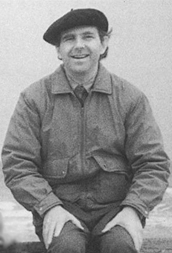
Jerome Roche took BA (1959-62), MusB (1964-67) and doctorate (1968) at St John’s College, Cambridge. Roche is known for his work on 17th-century Italian church music, and published monographs on Palestrina (1971) and Lassus (1982). He also published editions of the music of North-Italian composer Alessandro Grandi, making his music more widely known, and several anthologies of madrigals and Italian church music.
Roche taught at Durham University from 1967 right up until his premature death in 1994. He was remembered for his committed Catholicism, a ‘beatific smile’, and a range of nicknames from Roash to Jerosh to Roatch.
See David Fallows, ‘Jerome Roche, 1942-94’, Early Music 22 (4) (November, 1994), 713-714; David Scott. ‘Roche, Jerome.’ Grove Music Online. Oxford Music Online. Oxford University Press.