Study Day report: ‘Chamber Music: Synergies through Time, Place, and Spaces’
Report written by Ana Beatriz Ferreira (Cardiff University) and Eleonora Savvidou (Royal Welsh College of Music and Drama).
The conference Chamber Music: Synergies through Time, Places and Spaces took place on 13 March 2026 at the Norwegian Church Arts Centre in Cardiff. Bringing together educators, researchers, and performers, the event celebrated chamber music in all its forms: its historical legacy, its enduring livelihood and its continued vitality. The intimate nature of the venue offered an ideal setting for the conference, reflecting the environments in which chamber music would have originally been heard.
The day began with a panel discussion on ‘Education and Engagement through Chamber Music’ with Lucy Green (Emerita Professor of Music Education, UCL), Susan Young (formerly Principal Lecturer in Music Education at Exeter University), Julia Plaut (tutor at the RWCMD and founder of the charity Little Live Projects) and Clíona Ní Choileáin (cellist of the ‘Hold the Drama’ chamber collective). A key theme that emerged during the discussion was literal and metaphorical definitions of ‘play’: both chamber music practices and the ways they are communicated to young children were brought into question.
I was delighted to participate in a panel session in this most interesting and unusual conference. While the focus was firmly on chamber music, the perspective and breadth of knowledge was broad. As well as being superbly organised, it was a truly inspiring event, and forged new relationships that I am sure will go on to produce even more fruitful results in the future.
- Lucy Green
The first session of the day – ‘Chamber Music for All’ – contributed further dimensions to themes which arose from the panel discussion. Giovanni Conelli (Naples Academy of Fine Arts) considered how the implementation of chamber music sessions within El Sistema frameworks offers participants the opportunity to engage with distinct forms of collective music-making. Adam Paul Cordle (University of Illinois Chicago) argued that well-designed chamber programmes contribute to the development of students’ craft and extra-musical skills in ways that are rarely, if ever, fostered through other applied musical contexts.
Following a lunch break, during which participants conversed around platters and drinks, the next session – ‘Salons and Stages’ – drew focus on historical perspectives of chamber music performance. To begin the session, Alba Brundo (Naples Academy of Fine Arts) traced how harp arias, detachable from their operatic context and performable in intimate chamber settings, served as a conduit through which the sonic intimacy of the salon was transferred to the theatre. Subsequently, Emmanuel Sowicz (University of Oxford) explored how each player in guitar quartet arrangements contributes to the formation of a collective identity, a concept he terms ‘chamberhood’. The session concluded with Steven Jeon (Independent Researcher) who considered how Britten’s pedagogical background and chamber practices influenced the composition of his Simple Symphony.
Following an afternoon break, the final session of the day – ‘Interdisciplinary Perspectives’ – examined socio-cultural aspects of chamber music. Martina Cuevas Cuevas (Trinity Laban Conservatoire of Music and Dance) presented a paper examining how chamber music offered Florence Ashton Marshall (1843–1922) a space to exercise musical leadership at a time when women were beginning to be recognised as professional musicians. Robert Plane (Royal Welsh College of Music & Drama / Cardiff University) then offered a portrait of the composer Pamela Harrison (1915–1990), raising questions about how her gender, professional dependency, and family life influenced her compositional output, which centred around small scale forms.
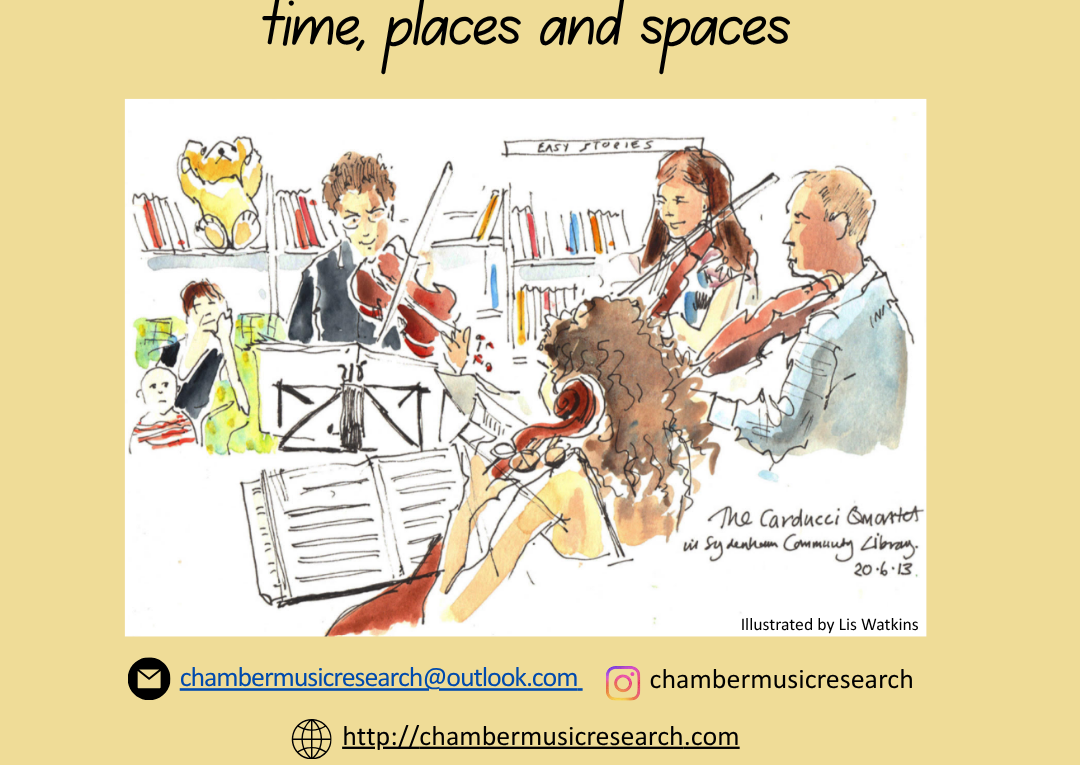
The academic programme was complemented by musical performances. Historically unheard voices were brought to life through a performance of the first movement of Pamela Harrison’s Clarinet Quintet, with students from the RWCMD and Robert Plane on clarinet, followed by a performance of the first movement of Florence Price’s Quartet in G major. The evening’s centrepiece was a performance of Mendelssohn’s Octet. Performed side by side by the internationally acclaimed Carducci Quartet and young artists from the Vita Quartet, the two quartets embodied the conference’s spirit of mentorship and intergenerational collaboration. As participants were invited to partake in the performance experience through an interactive word cloud, key themes and values which characterised the day were brought to the fore: conversational, synergistic, delightful, cheerful, exhilarating, interesting, fun, gratefulness, liveliness.
The conference was a vivid reminder of the unique power of chamber music to bring people together—artistically, intellectually, and personally. It was a truly special day, shaped by generosity, curiosity, and a shared love of music-making.
- Emma Denton, Carducci Quartet
The day concluded with the keynote lecture delivered by Laura Tunbridge (Heather Professor of Music, University of Oxford). Under the provocation ‘Do we need to have a conversation about this? “Playing Chamber” in the twenty-first century’, Laura interrogated the long-standing metaphor of chamber music as conversation, asking how meaningful such a metaphor remains for players and audiences in the digital age and arguing that the act of talking and playing together ‘in the room’ remains the irreducible heart of chamber music practice.
A drinks reception brought the conference to a close, offering participants the opportunity for precisely the kind of open dialogue that, as the day’s proceedings had repeatedly suggested, lies at the very core of what chamber music is.