Interview with 2024 Practice Research Prize Winner Dr. Lauren Redhead
Congratulations to Dr Lauren Redhead, winner of the RMA 2024 Practice Research Prize. In this interview, conducted by junior student representative Günseli Naz Ferel, Dr Redhead discusses her journey in practice research and how it relates to her own work as a musician.
Günseli Naz Ferel (GF): First, congratulations on receiving the RMA Practice Research Prize for 2024 and thank you so much for taking the time to be part of this interview. Could you explain how you conceptualise and work with practice research in your academic practice, particularly in terms of its theoretical foundations and methods, for our student audience who might be new to this field?
Lauren Redhead (LR): Thank you, and thank you for inviting me to this interview.
In some ways, I don’t think practice research is any different to any other type of research in its conception: my own research questions are driven by curiosity and problem-solving, which I think is the case for many researchers in the arts and humanities. Creative practice is one of the methods of investigation that I have open to me, and in making that statement I’m also making the statement that knowledge inheres in practice, so creative practice itself can be a means of investigation or a pathway to knowledge. What is important for practice researchers is to identify that knowledge, sustain it, and share it with others; that’s what is different about engaging in practice research compared with engaging in creative practice outside of a research context. I do firmly believe that many practitioners experience their practice as a pathway to or a form of knowledge, they may just not have a reason to share their work in the same way.
What I think is interesting about methods in practice research is that on the one hand it is possible to talk about overarching methods that researchers can use—which can include processes like testing, workshopping, iteration, reflection, etc.—but also there is the idea that methods are ‘emergent’ within a project, and so are somewhat bespoke to each instance of research. That can be confusing for new researchers because they don’t have a blueprint that they can follow exactly. But really what this means is that there is no single way to do practice research, just as there is no single way to do creative practice, and so researchers are tweaking and refining their methods as they move through their research projects and find out more about them and about what they are researching.
For someone who is new to this area and maybe grappling with this, I would say: you are the expert in your practice already, but because of this you need to do the work of making the creative and knowledge processes you engage in open and accessible to others. A lot of practice research is about doing that work so that, rather than only having the impetus and the final artwork, the audience are able to see into the process and understand what was done, why, and what was learned through that process. That is what it means for the research to be ‘effectively shared’.
GF: Would you mind giving us an overview of your research project “54 stops, grésillement, alphabet des rauschens: collaboration and/as performance autoethnography”?
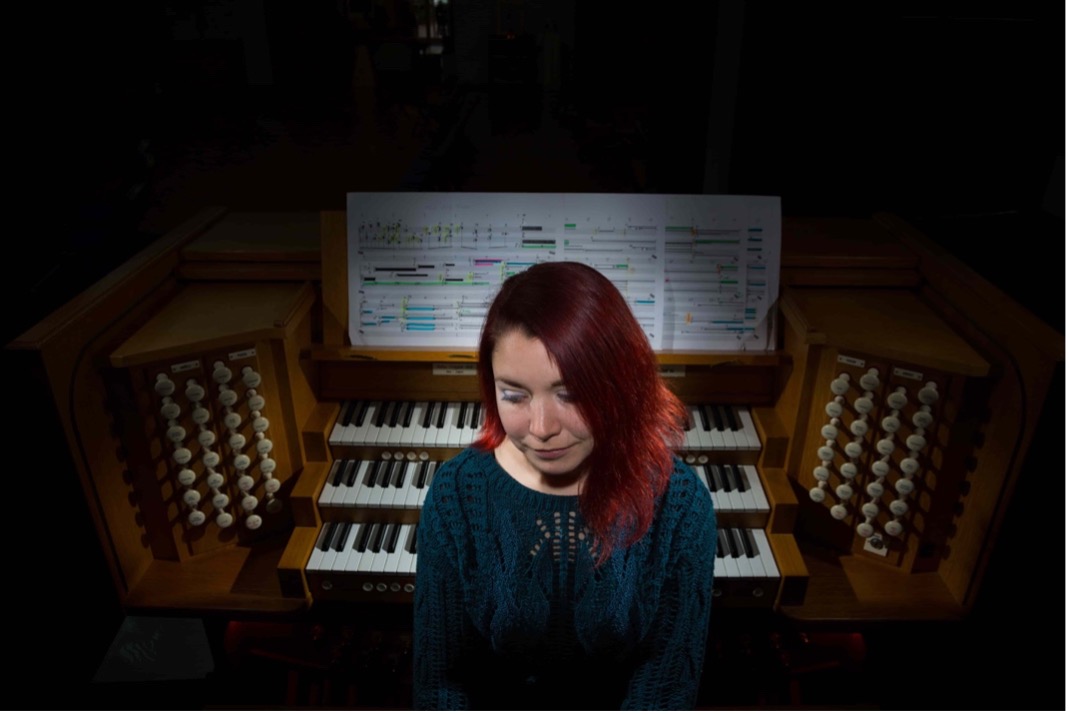
LR: This was quite a long project and a very rewarding one. It began with the invitation from Swiss composer Annette Schmucki to write a piece for my duet of organ and electronics with Alistair Zaldua. At that time my main research questions were about the heterogeneity of organs and how that could be framed as a compositional affordance. Annette was really keen that we had a genuine collaboration and not just an exchange of information about the organ, which is how some projects can be. At first, we had a very long email exchange which was about organs, how they work, how it is possible to compose for organ and electronics, contemporary music more generally, and inevitably our lives around that time as well. From this email exchange, Annette created some scripts that were recorded by Alistair and I, and from those scripts she created some audio scores that combined the recordings, and a score that was based on a series of instructions and a new script combining some of the recorded statements. The idea is that in performance, the organist and the live electronics performer respond to their own voice in the audio score, aided by a series of cues about sound, timbre, aesthetic/poetic idea, etc. In reality, this can’t be done in real time—I had to create a score for myself that is nearly 50 pages long, and Alistair created a programme in max/msp that includes a lot of additional recordings he made or selected. In addition, the performance can take one of three durations: 12 minutes, 45 minutes, or 2 hours. We’ve now performed the piece many times, including the 2 hour version twice, and recorded the 45 minute version for a radio broadcast.
Even this description, which is quite long, doesn’t capture all of the complexity of this exchange! And so during this project, while my interest in heterogeneity that started off the commission was still there, other themes started to emerge. These were about how the collaboration and exchange could be documented and studied, but also how it was inscribed in the music itself. I was interested in how the piece was becoming a personal record not only of the collaboration, but our individual perspectives on it. This became a question that I felt could be answered via performance autoethnography, and I explored how the way that the piece had been created already supplied autoethnographic information on behalf of each participant: Annette had created the audio and the score which gave information about her perspective on our developing exchange; the max/msp patch and the audio contained within in gave information about Alistair’s interpretation of the score and its instructions; the score that I had created for myself along with my performance decision-making (that included organ registers as well as notes and playing techniques) did the same in terms of evidencing my perspective. This led me to conclusions not only about what happened in this particular exchange, but also about how performance autoethnography can be used as a tool for working with creative practice materials rather than just describing or analysing them.
This is also an example of emergent methodology: I started with one question but that expanded as the practice went on, and as it did so the practice itself suggested the best methods to interrogate it and how to develop their use. So I hope that what I have ended up with is not only a set of conclusions about what happened on this occasion in this collaborative exchange but a proposition for a way of working that other researchers could use and develop in their contexts as well.
GF: Can you tell a bit about your academic and artistic journey and how you came to be interested in practice research?
LR: I did all of my studying at the University of Leeds, and was very lucky to receive AHRC funding for both my MMus and PhD work there. I was mainly working in composition at the time, and there were two key things that probably led me to thinking about research quite deeply: the idea in modernist composition that the discourse of material within a piece can be a form of enquiry, and also my interest in aesthetic thought and the idea that this discourse of musical material could itself be used to create and interrogate aesthetic arguments. My PhD research was broadly about both of those things. I was also interested in practice research during my PhD because I felt strongly that composition could be a method of doing research, but I often felt I lacked the tools to really express or explain why this was so. On the one hand, this didn’t matter because I was working with supervisors and in a department of people who all supported composition as research. But on the other hand, I would sometimes come across a national discourse that was sceptical of the idea.
Immediately after my PhD, I started to work on the idea of practice research itself: at first, I was interested in describing this in epistemological terms, and finding examples of music and practice that exemplified this. I was both looking for models that I could use to develop my own work, and that I could use to explain what I was doing or trying to do to others. By doing this I came across lots of music and practice that I probably would not have done if I had kept my research focus only on my area of musical interest. I also became involved in a lot of discussions in the places where I worked (at the time, the University of Surrey and then Canterbury Christ Church University), and nationally, about practice research and how it is funded, supported and celebrated.
As a result of this, some things then followed: I became the co-director of the Centre for Practice Based Research in the Arts at CCCU, and I became involved with what became the Practice Research Advisory Group (PRAG) via a conference at Goldsmiths organised by Prof Simon McVeigh and Prof Mark D’Inverno. So now part of my job was to promote practice research within my institution, to help develop practice research projects with a particular focus on REF, and to provide training for PhD students in practice research. And at the same time, I was involved in a national conversation about how practice research could be better represented and supported beyond our institutions. This also started to change my research focus from looking at the epistemological arguments for practice researchers to its phenomenology: what do practice researchers actually do, and how do they experience research and knowledge?
I’ve since moved to Goldsmiths, and my work has further changed to supporting researchers in other kinds of ways. I’ve also supervised a lot of PhD students in this time, and have been involved in developing practice research curriculum for PGT students, and I think some of my focus has turned to pragmatic questions of what can practice researchers do, and how can they do it? Practically, this has become a focus on methodology and ethics and how to support new or established researchers in developing, embedding, and narrativising these elements in their projects.
All of these experiences have definitely influenced how I’ve gone about my own research, too. I think there are some key lessons:
- Trusting, and accepting my musical interests as central to identifying research questions. My most successful research projects have been centred around things I was deeply interested in, rather than questions I might have felt I ‘ought’ to research.
- Aiming for clarity, and trying to make situations that feel complex clear in the way I present them and write about them. I’d say that this is always going to be a work in progress, but I now see complexity as the indication that there is more to know and to unpick about a situation.
- Looking for answers and inspiration outside of my area of music, or outside of music itself. A really great outcome of my research about practice research itself has been meeting researchers from lots of different disciplines and learning from and being inspired by them. No one discipline has a monopoly on creative practice, and so looking beyond your own discipline is a great way to find methods and approaches that can help to develop your own disciplinary research.
GF: How does reflecting on performance and focusing on practice research influence your approach as a musician?
LR: I think I’ve partly answered this in question 3, so I’ll just add to that answer.
Probably the biggest influence, that I only briefly mentioned, is about developing a personal approach to your own practice. I don’t think that practice research is the only reason that someone would do this, but it has been helpful for me because practice research has values that are different to other contexts for music. The professional world for contemporary classical music composition and performance is very competitive, and often seems to require people to work in a way that isn’t always right for themselves or their practice. But it can also be difficult not to take part in those ways of working because it feels like, if you don’t, you’ll lose the opportunities to write or to play music that you need to develop your career. Even if you work in a university, it can feel like you still have to be successful in those external contexts as well for your work to mean anything. But within practice research, the value isn’t necessarily on the final product or its reception. It can be on the process, the methods, on developing aspects of documentation, or on reflections that come from practice. There’s no limit on what the practice should be for these things to be ‘good’ or ‘successful’. There are certainly different systems of value to traditional virtuosities or stylistic considerations, or to working with certain individuals or festivals. For me, a context where value comes from the work and can be articulated by it is refreshing.
Some decisions that I have made as a result of those considerations have been only to perform music of living composers, to focus on new work for the organ and collaboration, and to prioritise collaborative relationships that I find meaningful. All of these mean I’ve stopped prioritising aiming for some of the things that the contemporary classical music industry values the most. But what has been interesting to me is that this hasn’t meant I’m never involved in performing at festivals, or working in those contexts outside of the university: it has just meant that I’ve found which of those things fit well with the work I really want to do. And I think that has also made me happier while doing it.
This isn’t to say that practice research contexts are without their own problems and limitations: we’re still all working in institutions and also in a national research policy context as well. How different institutions and research managers translate that can be different and work better or less well for different people. I think there is always work to be done in improving our working environment, but I would emphasise that the concept of practice research itself is not the origin of those problems, and it does contain the values that could contribute to finding solutions.
GF: Looking back on your career so far, how have your research interests developed? Could you share any guidance you might have for students or early career researchers finding their way in the field?
LR: Again, I think my answer to question 3 explains this a little bit in terms of the development of my practice research interests. Outside of that, in some ways, I can see a lot of links between what I am interested in now, and what I was interested in at the time of doing my PhD. For example, the aesthetic properties of musical discourse and nonlinearity. The two other key themes that I think have emerged across my research since completing the PhD are heterogeneities and materialism. A lot of my research at the moment is focused around graphic and experimental forms of notation, which wasn’t really a part of my PhD research but has become a key element of my research in composition and performance. The other thing that has developed for me is writing about music. Analysis and interrogation of contemporary music was a part of the work I did during my PhD, and this has developed for me in particular in terms of writing about living composers, and composers about whom there isn’t yet a lot of writing in English. I want my writing to be able to make that music accessible and interesting to more people.
Something I can definitely also say is that I can see iterative development across lots of different projects, where some of these themes emerge. I can see how that can also be something that other people experience and then it can feel like a barrier to identifying discrete projects or research questions for different parts of the work, because everything feels connected. I’ve definitely experienced that, too. I saw Scott McLaughlin present a diagram about his work where he talked about the overarching development of his research theme, and the branching projects that individually relate to that but investigate their own questions. That’s a really helpful way of thinking about it: there are overarching research questions and themes that I revisit, but there are also specific questions that I ask in specific situations or instances of practice.
If I have any additional guidance to offer outside of these thoughts, it would be to share your research with as many people as possible. That could be at conferences, just through discussions with other people in your research area, or through groups like the RMA’s Practice Research Group. If you can, share your work in progress as you are developing your projects. This can be quite a scary thing to do, but I believe that people are very receptive to this, and I can’t overstate the benefit that I’ve drawn from discussion, collaboration and sharing. That is definitely one of the main ways I’ve been able to develop my research and problem-solve, and in addition feeling part of a research community has been a great benefit and source of inspiration and support. If you are involved in contemporary music at all, the RMA’s Music and/as Process Study Group events can be a great place to share ongoing work. I used to be involved in the organisation of that group, although I am not anymore I still enjoy attending their events and would really recommend them to others.