
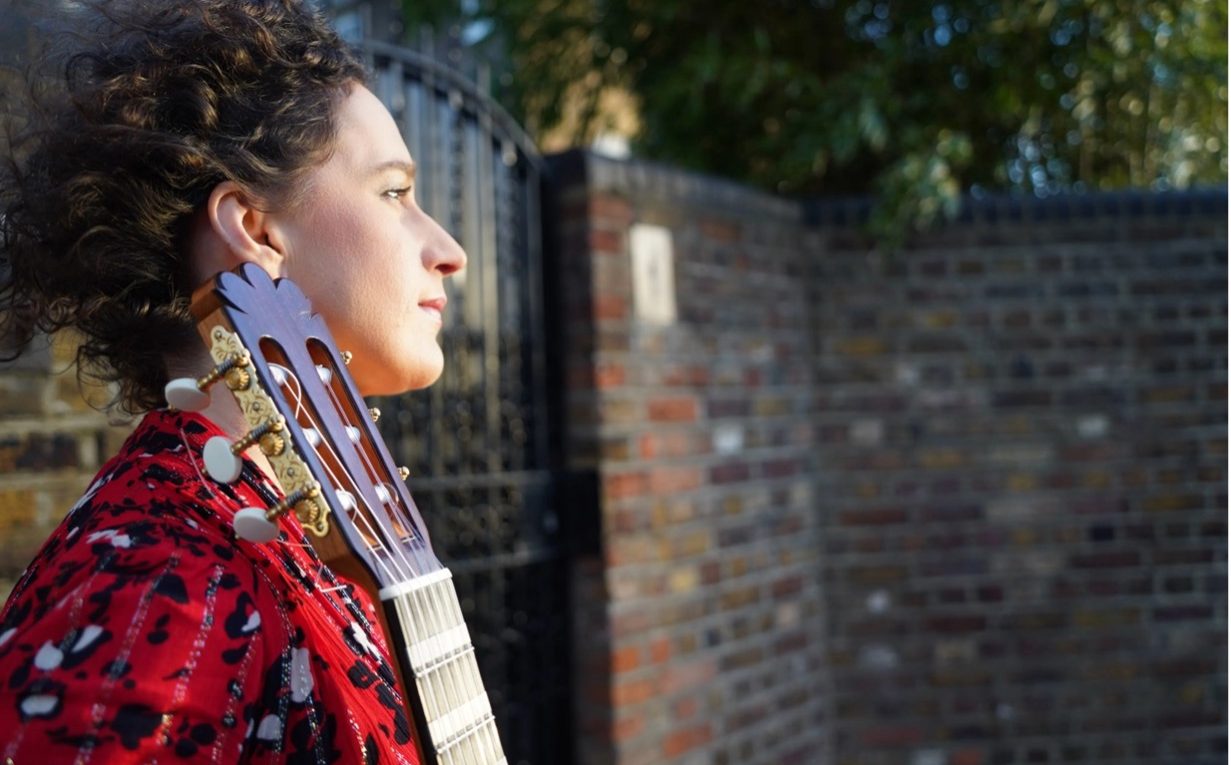
Interview with 2024 Practice Research Prize Winner Dr. Katalin Koltai
As part of our series of interviews with RMA prize winners, our student representative, Günseli Naz Ferel interviewed Dr Katalin Koltai, the 2024 RMA Practice Research Prize winner. In this interview, Dr Koltai reflects on her academic journey in practice research and Ligeti Guitar and shares insights into her artistic practice.
Günseli Naz Ferel (GF): Please accept our congratulations on receiving the Practice Research Prize for 2024 and thank you so much for taking part in this interview! Would you like to begin by telling us the path that brought you into practice research, through your academic and artistic experiences?
Katalin Koltai (KK): Thank you for this opportunity. My path into practice research grew out of a fascination with musical instruments and the discovery of new repertoire. I am an active performer, guitarist and collaborator, and I approach research very much through the lens of a practitioner. My lived artistic experiences constantly generate my research questions. For me, practice and research are inseparable—they are two sides of the same process.
GF: Could you give us an overview of your innovative artistic research with the Ligeti Guitar—how it began, how the instrument has evolved, and the kinds of new performance practices and repertoire it has opened up?
KK: I have always had an innovative approach to the guitar and other plucked instruments. Rethinking idiomatic boundaries—and how they affect music—has shaped my work, particularly when arranging. The Ligeti Guitar project began with my fascination for the soundscapes of Bartók and Ligeti. I noticed that while the characteristics of certain piano pieces seemed to evoke the guitar, their textures were incompatible with the matrix of frets and strings.
To address this, I experimented with designing attachable tools—single and double magnetic capos—that could extend the guitar’s affordances, especially in vertical shapes. This Magnet Capo System proved remarkably successful, as shown in my arrangement of Bartók’s The Night’s Music. Building on this breakthrough, I began to explore how to realise Ligeti’s pitch sets in Musica ricercata, which required a redesigned fretboard. This led to the birth of the Ligeti Guitar.
Soon, I realised that the design could be developed even further for greater versatility. I refined the instrument into what I now call the Open Frets Guitar: https://youtu.be/qSzSbs-LRPo
My current focus is on how this guitar can expand accessibility—both in pedagogy and in community music-making—while also opening up new possibilities for composition and performance.
GF: Can you tell us a bit about the questions you explore in your field and how your conceptualisations of practice research transformed through your academic and artistic journey?
KK: I am fundamentally interested in how instrumental affordances shape our musical language. This question can be reframed in different contexts—composition, improvisation, pedagogy, or community practice—but at its core, I am exploring instrumental space and its relationship to musical processes. Over time, my academic and artistic journey has helped me see these as deeply interconnected: the way we design, adapt, and play instruments feeds directly into the way we think and create music.
GF: Would you like to reflect on how practice and artistic research shape the collaborative dimensions of your artistic work?
KK: Collaboration is central to how I create music. Our colleagues, surroundings and audiences all influence how we experience and think about music. My early training as a classical guitarist at the Liszt Ferenc Academy of Music—within a fairly conservative environment—was a key factor in shaping my outlook. Not fully identifying with the aesthetic and traditional values of the set repertoire and performance traditions actually pushed me to forge my own path.
From my graduate years onwards, I began working closely with composers to create new music and joined communities of improvisers, composers and instrument inventors. These collaborations have been invaluable. They allowed me to exchange ideas, learn from others’ practices, and find inspiration for new directions in my own work.
GF: Can you tell us about the key moments that have shaped your academic and artistic journey, and what insights you might share with emerging researchers as they navigate their own paths?
KK: A recent highlight was premiering a new work for the Open Frets Guitar by Hans Abrahamsen, developed from his earlier piano works such as October for left hand and the concerto Left, alone. It was a wonderful example of shared creative practice, and I am deeply grateful for the opportunity to collaborate with him.
Another key moment was having the opportunity to teach as a Postgraduate Lecturer at the Royal Academy of Music this year and starting a position at IRCAM as a Visiting Researcher, both of which are immense honours.
For emerging researchers, my advice would be: allow your artistic practice to guide your research questions, and don’t be afraid to create your own path.